

Data import
You can import data into CloudBeaver from various file formats. Start the import process from the Data Editor.
Supported formats
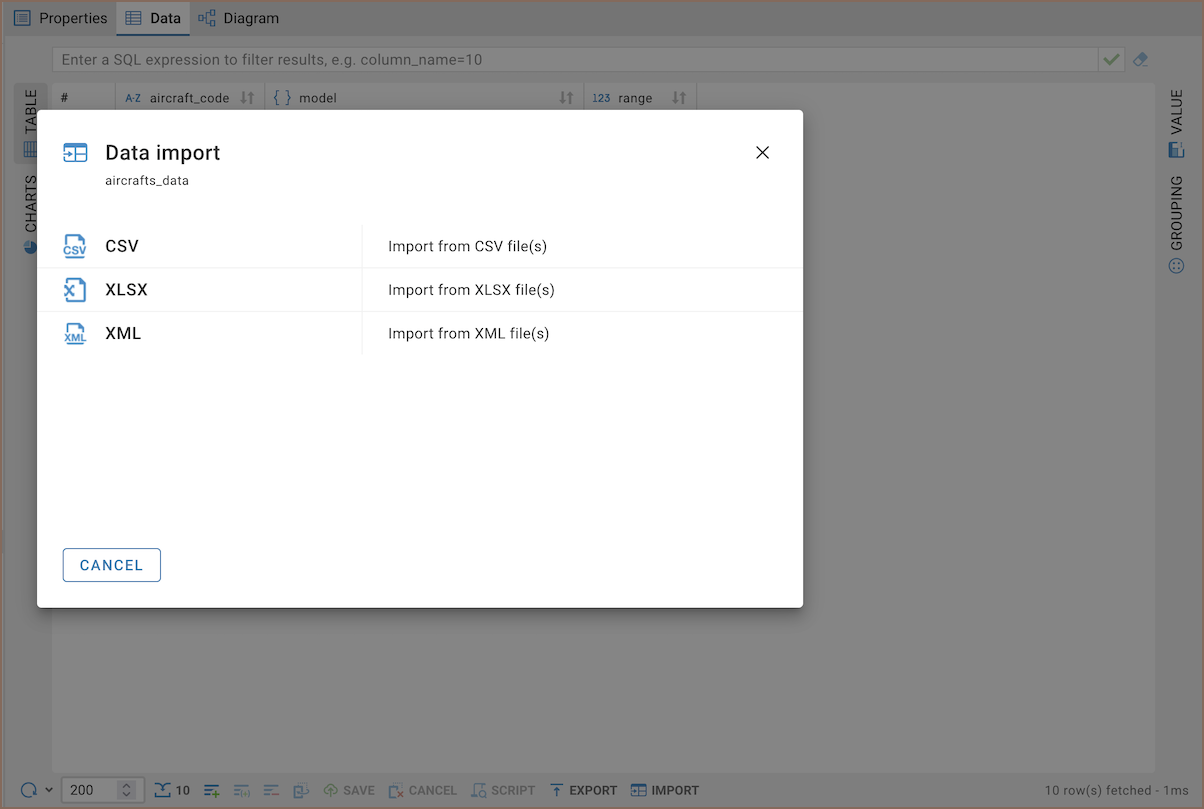
CloudBeaver supports the following formats for data import:
- CSV
- XML

- XLSX
Steps to import data
To import data to the CloudBeaver, follow these steps:
- Select the table where you want to import data and click Import (
 ) in the bottom toolbar.
-
Pick the format you need from the list of available options.
-
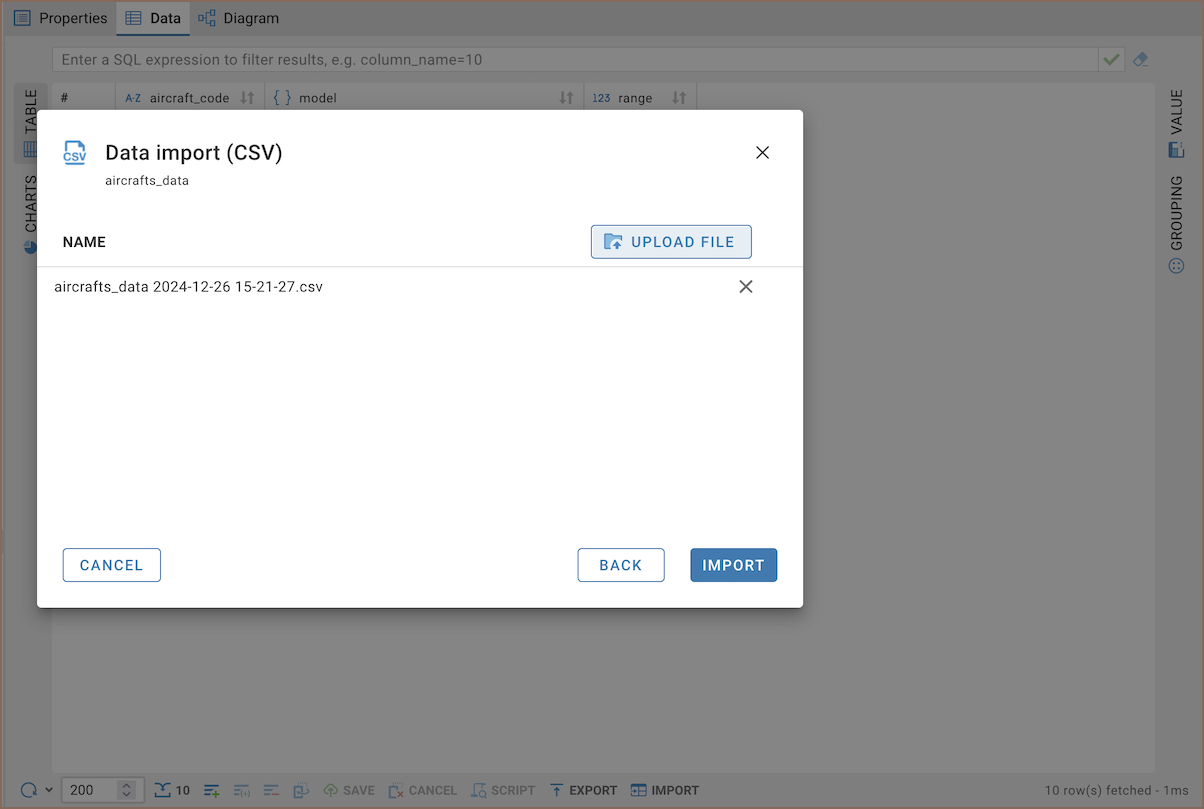
On the File tab, select and upload the file from your local storage.
Note
The import runs in the background, so you can keep working without interruptions.
-
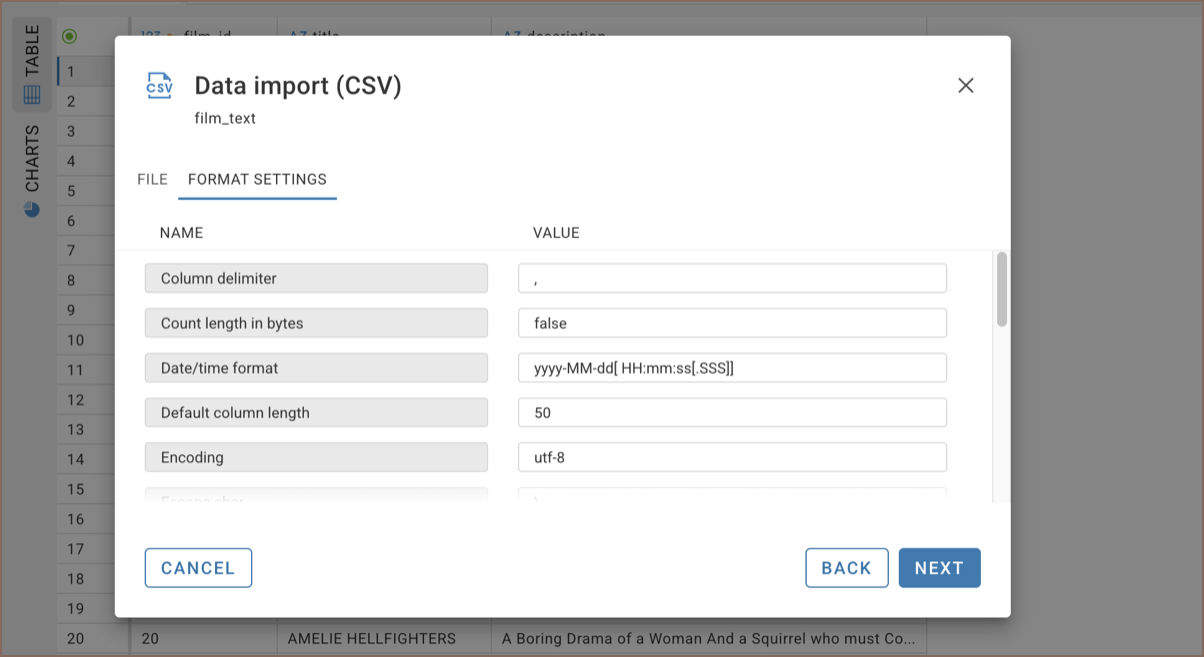
On the Format settings tab, configure how to read the file. The available settings depend on the selected format.
Info
For details, see Format settings.
-
Select Next to configure the database settings:
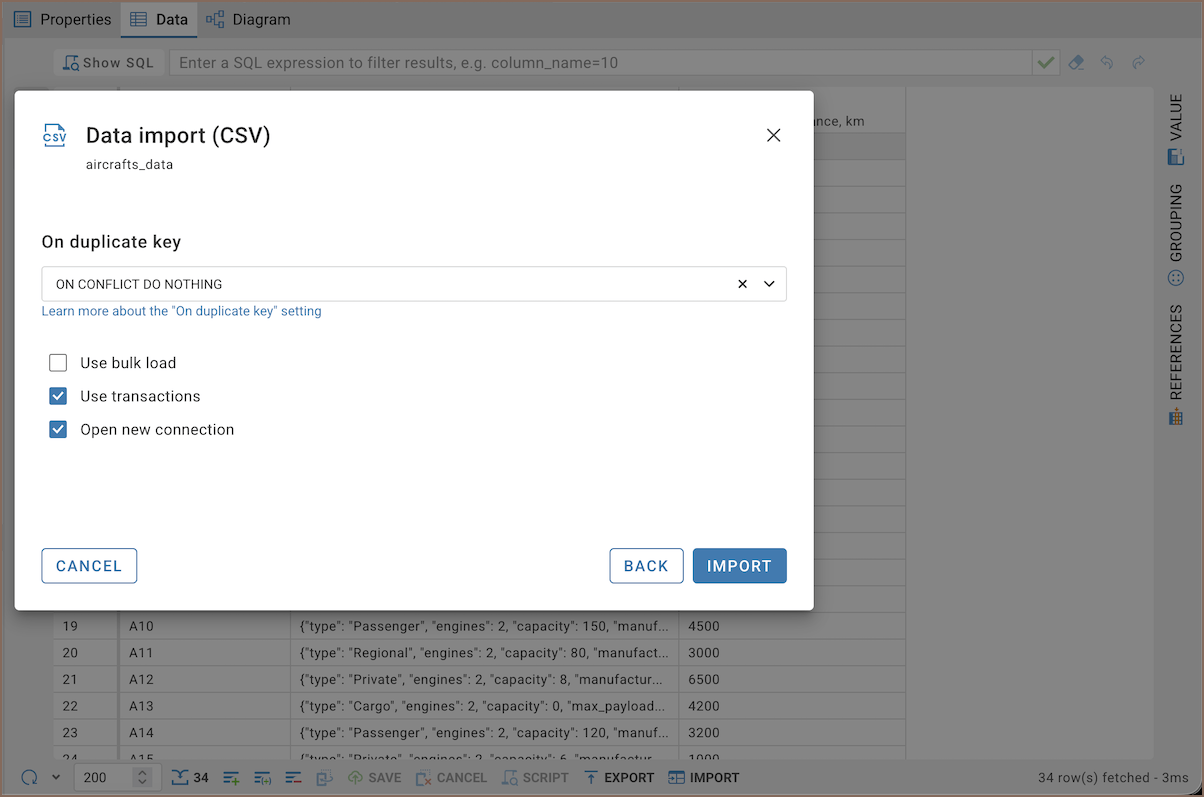
Setting Description On duplicate key Select how to handle rows that contain a primary key or unique key value already present in the target table. For details, see Data import and replace Use bulk load Use bulk loading for faster import. This setting disables On duplicate key Use transactions Execute the import within a database transaction. If the import fails, all changes can be rolled back Open new connection Open a separate connection for the import so it doesn't interfere with other calls to the target database Note
On duplicate key, Use bulk load, and Use transactions appear only when the target database or driver supports them.
-
Select Import to start the import.
- Check for a confirmation message indicating the import was successful.
Format settings
CSV
| Setting | Description |
|---|---|
| Count length in bytes | Column length measured in bytes instead of characters |
| Default column length | Default length for new string columns |
| Sample rows count | Number of rows to analyze to estimate column length and data types |
| File extension | File extension to recognize, such as csv, tsv, or txt |
| Encoding | Character encoding of the file (for example, UTF-8). |
| Column delimiter | Character that separates columns. You can also use special symbols like \t (tab), \n (newline), or \r (carriage return). |
| Header position | Defines if the first row is used as column names (top) or if the file has no headers. |
| Quote character | Character used to wrap values (for example, "). |
| Ignore characters outside quotes | Any characters outside quotes that should be ignored during parsing. |
| Escape character | Character used to escape special characters (for example, \). |
| NULL value mark | String used as a marker for NULL. These values are imported as NULL. |
| Set empty strings to NULL | If enabled, empty strings are converted to NULL. Otherwise, they are kept as empty values. |
| Date/time format | Pattern that defines how to read date and time values. Doesn’t change the output format. See java DateTimeFormatter for details. |
| Trim whitespaces | Removes spaces before and after values to prevent parsing errors. |
| Timezone ID | Timezone for date/time values. By default, the local machine timezone is used. You can set: - A local offset (e.g., +3, -04:30)- A GMT/UTC offset (e.g., GMT+2, UTC+01:00)- A region ID (e.g., UTC, ECT, PST). |
XML
| Setting | Description |
|---|---|
| Extension | File extension to recognize |
| Column read method | Defines how to extract values from XML. Options: - elements - use nested elements inside item elements - attributes - use attributes of item elements - both - use both elements and attributes |
| Item element | Name of the element treated as a row (item). If empty, any second-level elements are treated as items. |
XLSX
| Setting | Description |
|---|---|
| Default column length | Minimum length for new string columns |
| Sample rows count | Number of rows to analyze to estimate column length and data types |
| Timezone ID | Timezone for date/time values |
| Extension | File extension to recognize, such as xlsx |
| Header position | Determines the location of the column names in the Excel table, either at the top or none. This setting specifies whether the column names are located in the first row of the Excel table or if there are no column names present. |
| Skip empty rows | If this setting is enabled, empty rows will be ignored. If the setting is disabled, all cells in the row will be filled with a NULL value. |
| Import all sheets | Specifies that all sheets in the file should be imported during the data import process. |
| Specific sheet name | Enables you to choose a particular sheet from the Excel file for importing during the data transfer process. |
| Date/time format | Use this setting to specify the date format used in the XLSX file. This is used to clarify the date format during the import process and does not affect the output data. |
Troubleshoot import issues
If the import fails, check the following:
- Use a supported file format. For CSV files, set Column delimiter to match the file.
- Make sure the table structure (columns) in your file matches the target table.
- Ensure primary key values are unique. To handle duplicate values, select a method in the On duplicate key list.