

JSON
Note
This feature is available in Lite, Enterprise, and Ultimate editions only.
This guide provides instructions on how to set up and use JSON files with DBeaver. The JSON driver supports standard JSON files and allows you to work with JSON data as if it were in a database. You can retrieve data and apply filters, sorting, and other operations, even combining data from multiple files.
Important
When using the JSON driver, all connected JSON files are read-only. To make changes, you need to update the original files outside DBeaver.
Before you start, you need to create a connection in DBeaver and select the appropriate JSON driver. If you haven’t done this, see our Database Connection article.

Tip
DBeaver can create a connection directly from AI Chat.
Upload one or more JSON files in AI Chat and click Open as table.
You can open and work with JSON files stored in your Cloud Storage directly in DBeaver. Double-click a file to create a temporary connection. Files opened during a session appear in the File databases folder in Connections. These temporary connections are removed when you close DBeaver.
JSON Files driver connection settings
This section describes how to set up a connection using the JSON driver. The connection settings page requires the following fields:
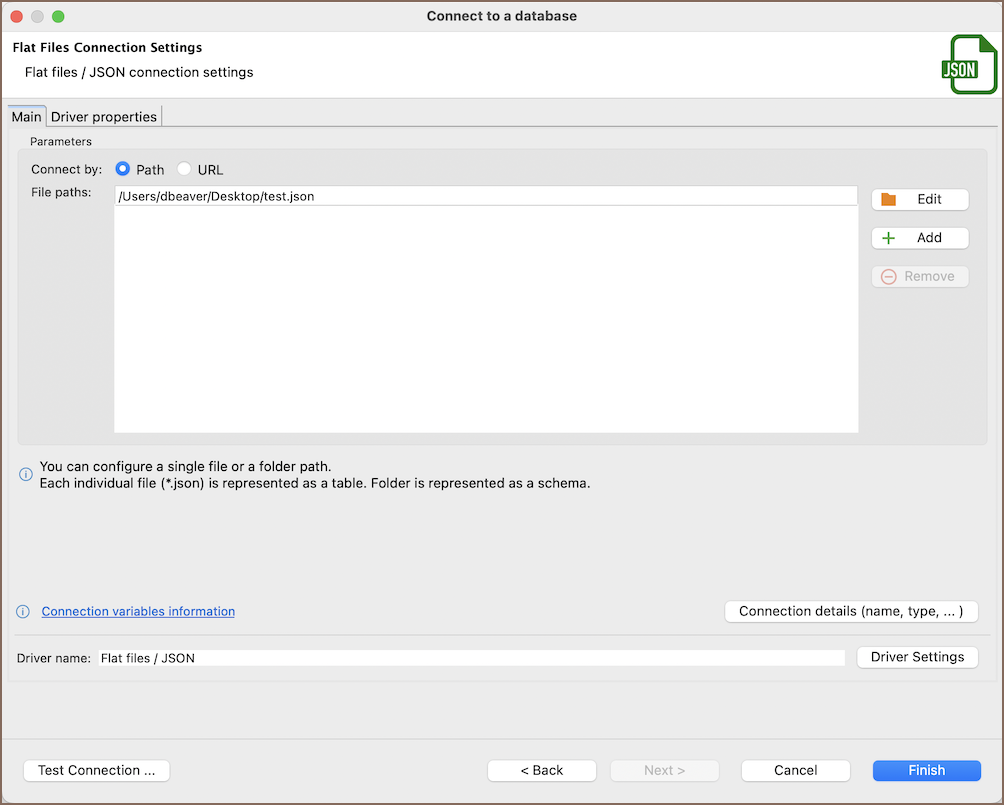
| Field | Description |
|---|---|
| Connect by (Path/URL) | Choose whether to connect using a local host path or a URL. |
| File paths | Specify the location of the JSON file(s). Choose an action: - Edit: Modify an existing file or folder selection. - Add: Add a new file or folder. - Remove: Delete a selected file or folder. When Editing or Adding, choose from: - File: Select a single file. - Folder: Choose a directory containing multiple JSON files. For more details, see Folder structure section. - Remote: Access a remote folder via Cloud Storage. This feature is available only in Ultimate Edition. |
| Driver name | This field will be auto-filled based on your selected driver type. |
| Driver settings | If there are any specific driver settings, configure them here. |
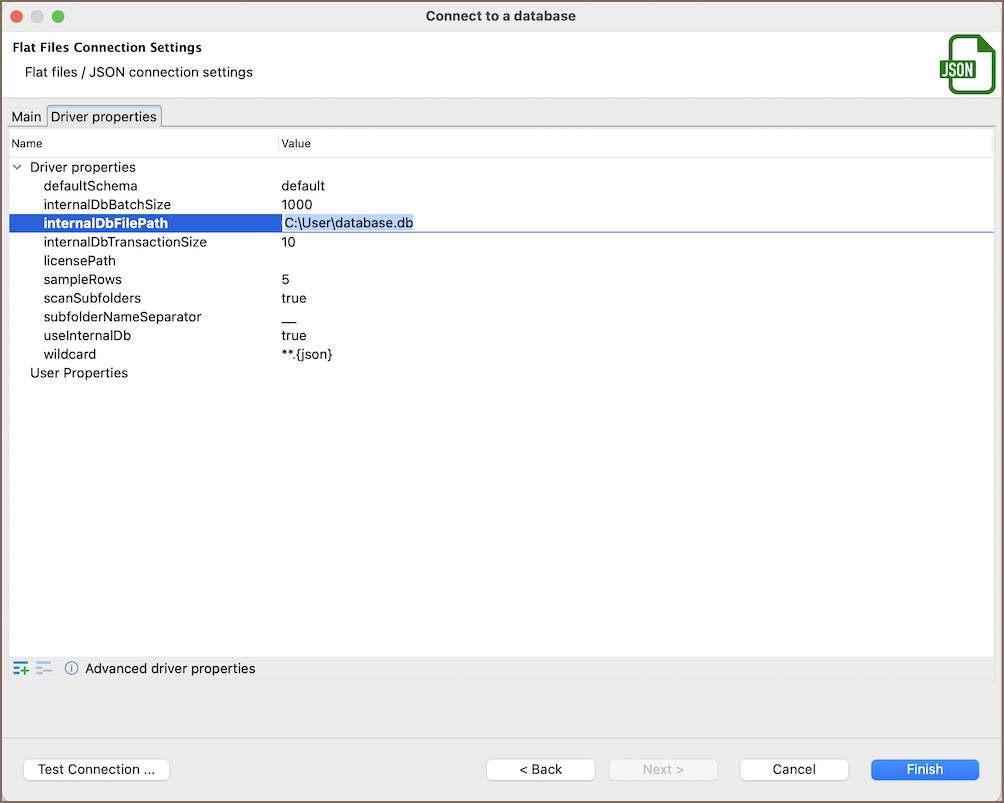
For details on driver properties, see File-based driver properties.
Tip
When using the Folder option, DBeaver scans the directory up to two levels deep for JSON files. For more information, see folder structure. If you select a folder, DBeaver organizes files in schemas based on their directory structure.
Features and capabilities
Advanced SQL query capabilities
The JSON driver supports the full range of SQL queries:
- Simple queries (e.g.,
SELECT * FROM table): Data is read directly from the JSON file. - Complex queries (e.g., using
WHERE,JOIN,ORDER BY,GROUP BY): When a complex query is executed for the first time, the driver imports the entire JSON file into an internal database to enable advanced SQL functions. Subsequent queries run faster because the data is already imported into an internal database.
Structuring JSON files with a schema
To enhance how DBeaver interprets JSON files, you can define a schema using a DDL (Data Definition Language) file.
Info
For information on creating a virtual database structure from SQL files, see DDL driver.
How to create a DDL file
- Create a
.ddlfile with the same name as your JSON file, placing it in the same directory (e.g.,employees.jsonandemployees.json.ddl). - Write a schema using the
CREATE TABLEstatement:
You can also use the WITH clause to set a data range - add firstRow and rowCount to your CREATE TABLE statement:
firstRow- row number to start reading from (default: 1)rowCount- maximum number of rows to read
Tip
You can also set firstRow and rowCount in the connection properties.
DDL file settings take priority.
Important
If the DDL file contains errors, DBeaver will ignore it.
Folder structure
When working with a folder containing multiple JSON files, DBeaver organizes them as follows:
| Folder structure | Schema in DBeaver |
|---|---|
| Root files | Default schema |
| Subfolder files | Schema named after the subfolder |
| Files in deeper folders | Ignored |
If your folder looks like this:
DBeaver will create:
Defaultschema:employees,salesReportsschema:monthly,yearly
Tip
To focus on specific files, consider selecting individual files or folders when configuring the connection.
Internal database
When you execute a complex query (such as WHERE, JOIN, GROUP BY, or ORDER BY.), on a JSON file for the first
time, the JSON driver processes the data by importing it into a temporary internal SQLite database.
By default, this internal database stores data temporarily on the disk during your session and is cleared when DBeaver
restarts. To speed up queries on the same file in future sessions, you can specify the internalDbFilePath option in
the Driver properties tab (e.g., C:\User\database.db) to reuse the processed data.
Additional features
DBeaver provides additional features compatible with JSON driver, but not exclusive to it:
| Category | Feature |
|---|---|
| Data Transfer | Data Export |
| Data Visualization | Visual Query Builder |
| Charts |